Showing posts with label fb. Show all posts

Tuesday, August 7, 2018

Facebook Changes How it Measures Video Ad Metrics

Facebook has updated its video ad metrics, bringing its metrics more in line with how people watch and interact with videos.

More specifically, Facebook is updating video ad metrics with respect to reporting the total amount of time a video was viewed.

Rather than focusing solely on duration, video ad metrics are evolving to focus more on consumption. Facebook defines consumption as ” the number of unrepeated seconds people watch.”

In addition, Facebook is introducing entirely new ways of reporting on video plays and removing some of the older metrics.

Measuring Consumption
Unlike video ads on other platforms, users can skip back and replay parts of a video ad on Facebook.

The way people are consuming video ads is changing, so Facebook’s metrics are evolving along with the change in user behavior.

Facebook will be updating the “3-Second Video Views” and “10-Second Video Views” metrics to count only unrepeated seconds. Those metrics will be updated in Ads Manager and Page Insights.


Measuring Video Plays

Facebook is introducing a new video ad metric that measures when someone sees a video ad playing.

Previously, Facebook may have reported on a video impression even though the video did not actually play due to the user’s settings.

The new “Video Plays” metric in Ads Manager will measure how many times the video was seen in motion on someone’s screen.

Removing “Redundant Video Metrics

Facebook will be removing the “30-Second Video View” and “Video Percentage Watched” metrics. The company says these metrics are now redundant and infrequently used.

Expect these updates to roll out globally to all advertisers over the coming weeks.

Reference : https://www.searchenginejournal.com/facebook-changes-how-it-measures-video-ad-metrics/264027/

Facebook Lets Users Sell Home Services in Marketplace


Facebook has recently added support for home services to its Marketplace platform.

With this update, home service professionals can market their service offerings to other Facebook users in their local area.

Previously, Facebook Marketplace was limited to only selling physical goods. So those without tangible products to sell were not able to utilize the platform.

According to the company’s announcement, millions of people turn to Facebook for advice on home services by asking friends for recommendations.


“More people ask for recommendations related to home services on Facebook in the US than any other topic. Since the beginning of the year, millions of people have asked their friends for suggestions related to home services, such as house cleaners, plumbers and contractors.”

Now, those looking for home service providers such as cleaners, plumbers, and other contractors, can find qualified professionals directly via Facebook Marketplace.

Facebook will be working with Handy, HomeAdvisor, and Porch to provide the following solutions to Facebook users:

An all-in-one destination to complete a home project — from proposal to completion.
Hundreds of thousands of top-rated professionals across the US.
Simplified decision-making by showing professionals’ ratings, reviews, credentials and location.
Making it easy to get quotes: simply describe the project you need help with and send your request to multiple professionals at once.
Real-time communications with service professionals via Messenger.
Support for home services in Facebook Marketplace has already started to roll out, and will be available across the US over time coming weeks. Marketplace is accessible via the Facebook mobile app.

Reference : https://www.searchenginejournal.com/facebook-lets-users-sell-home-services-marketplace/255311/

Sunday, July 29, 2018

Facebook’s New “Memories” Page Highlights Engaging Posts from Years Past


Facebook has introduced a new home on the web that users can visit to reminisce on top posts they’ve published throughout the years.
The new “Memories” page features a collection of of top text posts, photos, videos, and major life events.
Facebook says the reason behind creating this page is because of the positive impact this kind of reflection can have on people’s mood.
From a marketing perspective, it can also be a great way to look back on the type of content that made the strongest impression with your contacts.
“Every day more than 90 million people use On This Day to reminisce about these moments they’ve shared on Facebook, and research suggests this kind of reflection can have a positive impact on people’s mood and overall well-being. This is why we’re updating the experience to ensure all of your memories are easy to find.”
The Memories page may include any or all of the following sections, depending on the kinds of updates you share on Facebook.
  • On This Day: Past posts and major life events from today’s date.
  • Friends Made On This Day: A list of friends you made on this date in the past, including special videos or collages that celebrate your friendversaries.
  • Recaps of Memories: Seasonal or monthly recaps of memories that have been bundled into a message or short video.
  • Memories You May Have Missed: Posts that you might have missed from the past week.
Not all memories are inherently good, however, and Facebook says it will continue to design and tweak these features in a thoughtful manner.
Memories are also personal, which means you can only view the memories page of the account you’re signed into. It’s not possible to view the memories page of another user.
To view your memories, visit facebook.com/memories.
Reference: https://www.searchenginejournal.com/facebooks-new-memories-page-highlights-engaging-posts-years-past/256879/

Facebook is Letting Some Users Promote Marketplace Listings


Facebook is testing a form of hyperlocal ad targeting by giving some users the ability to promote Marketplace listings to their neighbors.
Promoted Marketplace listings will also show up in the regular news feed as sponsored posts.
According to TechCrunch, Facebook says this is a small, US-based test and the results will be monitored closely. There are no immediate plans for a wider rollout at this time, which presumably means the company is waiting to see how users respond to this feature.
Just like other promoted posts on Facebook, users can set their own budget and choose how long they want the campaign will last. Promoted listings will automatically be removed when an item is sold.
There are no specific targeting options for promoted Marketplace listings, as they will automatically be targeted to users with nearby ZIP codes.
However, once the listing has been promoted, targeting will be auto-optimized based on clicks. That means Facebook will show the promoted listing to users of a similar demographic to those who have clicked on it.
Prices for promoted Marketplace listings will be determined by an ad auction. When a user pays to promote a Marketplace listing it will be considered alongside other promoted listings that are targeting people in the same area.
The purpose of the ad auction is to calculate which promoted listing delivers the greatest value for both the advertiser and the users being targeted.
Facebook’s Marketplace was launched less than two years ago, and this marks the first time that users have been able to pay to boost their listings.
Reference : https://www.searchenginejournal.com/facebook-letting-users-promote-marketplace-listings/256771/

Facebook Now Supports Bidding for In-App Advertising


Facebook is rolling out the ability for app publishers to include Facebook ads in their ad auctions.
This process is facilitated by a technology called header bidding which was introduced last year.
Header bidding allows web publishers to put ad impressions up for auction through real-time bidding between ad networks.
Previously, Facebook’s support for header bidding was limited to advertising on the mobile web. Facebook now supports header bidding for in-app advertising.
App publishers that utilize header bidding now have the option to include ads from the Facebook Audience Network in their auctions.
The company describes how this process will work in its official announcement:
“Currently, ad networks are called one-by-one until an app ad is filled, determined by historical average CPMs rather than which buyer is willing to pay the most. This method often overlooks a network willing to pay more for an impression because it is lower in the chain.
App bidding enables app publishers and developers to establish an impartial and open auction over their ad inventory. All advertising networks are called simultaneously and the highest bidder for the placement wins, thereby providing publishers with opportunities to earn more. Publishers can maximize their access to high value advertisers, fueling the creation of sustainable ad businesses that help ensure people continue to enjoy access to high quality free content.”
Facebook’s app bidding solution has been in testing with a limited number of publishers for the past several months. These publishers have reportedly revenue increases of up to 40% as a result.
Reference : https://www.searchenginejournal.com/facebook-now-supports-bidding-app-advertising/256361/

Facebook Removes ‘Trending’ Section Due to Lack of Use


Facebook has removed the ‘Trending’ section from its platform, first introduced in 2014, saying it has become less useful over time.
Trending was added to the Facebook platform as a way to help people discover popular news topics.
Publishers shouldn’t notice any dip in traffic as a result of this change, as Trending apparently accounted for less than 1.5% of clicks to news sites on average.
The lack of interest in Facebook’s Trending section could be due in part to the company never fully getting behind it. For example, during its 4 years in existence it was only ever rolled out to 5 countries.
rending will be removed from Facebook within the next week. Products and third-party partner integrations that rely on the Trends API will also be removed.
The company says it plans to replace Trending with other news experiences in the future:
“We’ve seen that the way people consume news on Facebook is changing to be primarily on mobile and increasingly through news video. So we’re exploring new ways to help people stay informed about timely, breaking news that matters to them, while making sure the news they see on Facebook is from trustworthy and quality sources.”
Facebook is currently running several tests in an effort to explore news ways of keeping people up-to-date on the latest news. Some of these tests include:
  • A “breaking” news indicator on News Feed posts.
  • A new section called “Today In,” which connects people to important news from local publishers.
  • A dedicated section in Facebook Watch where people can view exclusive news coverage.
Reference : https://www.searchenginejournal.com/facebook-removes-trending-section-due-lack-use/255901/

Facebook Puts an End to Temporary Reaction Buttons


Facebook will no longer be releasing limited-time reaction buttons, which people could use in place of standard reactions or the like button.
So those who have been waiting for Facebook to release a ‘pride’ reaction to commemorate Pride month won’t be getting one this year.
Last year, during the month of June, Facebook rolled out a rainbow pride flag that people could use to react to posts and/or comments.
Facebook has done this several times before. A purple flower reaction button was available for Mother’s Day in 2016 and 2017. The company also released custom reaction buttons in 2016 to commemorate Star Trek’s 50th anniversary.
This year Facebook did not release a purple flower for Mother’s Day, and appears to have no intention to release a Pride flag for the month of June.
Lisa Stratton, a Facebook spokesperson, tells Business Insider:
In place of the custom reaction, Facebook is commemorating Pride month in other ways. This includes custom profile picture frames, backgrounds for text posts, along with filters and stickers for use in Messenger and the Facebook camera.
These Pride-themed additions to Facebook will be available for the entire year, not just the month of June.
Instagram, which is owned by Facebook, will have a type of Pride reaction that can only be used in live stories. Instagram also has Pride stickers, which have always been available to use in stories.
So there will still be plenty of rainbow pride to be found on Facebook properties this year, just not in the form of reaction buttons.

Facebook Introduces Ads in Stories After Reaching 150M Daily Viewers


Facebook has finally started including ads in Stories, which some might say was only a matter of time.
After being relatively quiet on the success of Facebook Stories since launching the feature 14 months ago, the company has revealed Stories now receive a total of 150 million daily viewers.With a sizeable audience of daily viewers, it appears that Facebook has decided the time is right to allow pages to run ads in Stories.
For comparison’s sake, it’s worth noting that it took Instagram only five months after launching Stories to reach 150 million daily viewers. This was also the time when Instagram began running ads in Stories.
Instagram Stories now reach at least 300 million daily users, since the number was last reported in November 2017.
Facebook began testing Story ads earlier this month in the US, Mexico, and Brazil. The ads are 5-to-15-second video clips, which users can simply skip by tapping through to the next story.
For now, the ads offer no benefit to brands other than exposure. There’s no click-through or call to action, though Facebook plans to add those features in the coming months.
Facebook also has plans to provide businesses with more detailed metrics on the performance of Stories, which can help determine whether running Stories ads are worth the investment.
Brands can run ads in Facebook Stories simply by extending their Instagram Stories ads to this new platform. Alternatively, brands can have their Facebook news feed ads reformatted into Stories ads, with color-matched borders and text at the bottom.
Reference :https://www.searchenginejournal.com/facebook-introduces-ads-stories-reaching-150m-daily-viewers/255347/

Why You Should Use Chatbots for Facebook Messenger Marketing


Did you know that more people are checking their chat apps than they are checking their social media accounts?
Facebook Messenger, the world’s largest mobile messaging app (with more than 1.3 billion monthly active users) offers a massive business opportunity to marketers.
By leveraging chatbots, brands now have the power to automatically engage with Messenger users.
This makes the mobile messaging app a perfect channel to connect, nurture, convert and up-sell customers. But how can you make everything work?

Why Marketers Should Care About Facebook Messenger Marketing

Messaging Apps Have Surpassed Social Networks

A report from BI Intelligence revealed that there are more monthly active users on the top four messaging apps (Messenger, WhatsApp, WeChat, and Viber) combined than there are on the top four social networks (Facebook, Instagram, Twitter, and LinkedIn).
The marketing opportunity is massive, yet only 1 percent of businesses can automatically engage with customers via messaging.
Focusing on Facebook Messenger makes sense because it has the largest active user base out of all mobile chat apps, not to mention they allow for the usage chatbot APIs.

You Can Get 10-80x Better Engagement vs. Email or Social Media

Facebook Messenger marketing has the best engagement rate for any marketing channel right now.
If you think about email marketing, you know you’re doing well if you can get an open rate of between 5 and 10 percent. On social media, organic post reach is now typically between 0 and 1 percent because of aggressive spam filters.
On the other hand, Facebook Messenger boasts open rates of 70-80 percent within the first hour.

‘Live Chats’ Are Slow & Need to Be Staffed 24/7

Compared to live chats, customer support via Facebook Messenger chatbots is a better solution for customers because they don’t have to wait on long queues just to address their needs.

Chatbot Basics: Facebook Messenger Chatbot Building Blocks

Facebook Messenger chatbots can be used for a variety of purposes. For one, a Q&A chatbot can answer users’ frequently asked questions.
Aside from this, chatbots can also be used for chat blasting where you can easily broadcast messages via Facebook Messenger to anyone who has already messaged your Facebook Business Page. This function can be used to deliver content like blog posts, webinars, or news about your business.
Chat blasting is conversion-friendly as it produces open rates as high as 75 percent. This is because the content that you can deliver over chat is substantially more engaging and interesting than what you send over just one-dimensional emails.
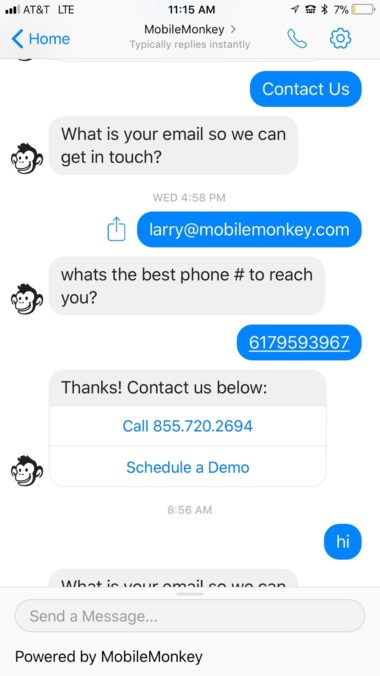
example-of-chatbot-convo
Example of a chatbot-powered conversation taking place via Facebook Messenger.

How to Create a Facebook Messenger Chatbot

To create a Facebook Messenger Chatbot, you can:
Using a visual chatbot builder is an alternative for marketers who have minimal programming knowledge as it enables one to create the content using a WYSIWYG editor.
There are two types of chat content that can be created on a visual chatbot builder:
  • Static Chat Content (e.g., texts, images, etc.)
  • Dynamic Chat Content (e.g., forms and quick questions): This type of content enables you to deliver more dynamic experiences to users. For example, to get the user input.
Other types of chat content you can send include:
  • Videos
  • Ebooks
  • Gift cards

2 Types of Chatbot Navigation Experiences

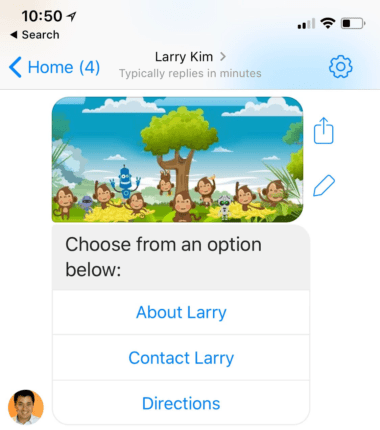
  • Button-Based Navigation
    • The chatbot provides users with menu options to choose from.
    • This is helpful because it offers them a scope of what the automated bot is capable of handling.
button-based chatbot navigation

  • Natural Language Processing
    • No menu is provided. The chatbot asks open-ended questions and the users can type in whatever they want.
      • The bot then analyzes what the user is asking for and will try to find a response that matches the user’s question or query.
    • For this to work, trigger keywords should be added when you create your chat pages. The chatbot AI analyzes the intent of the user request then serves the correct page you previously created.
natural-language-processing-for-chatbot
Tip: Periodically Review All “Unanswered Questions” and either create new content or point those user queries to existing content.

Chat Blasting: Features & Restrictions

Once you have implemented your chatbot, you can chat-blast anyone who messages your Facebook page (subject to a few restrictions), as well as gather their contact information.
You will also be able to send immediate chat blasts or schedule a Messenger drip campaign.
That said, there are also a few restrictions when chat blasting on Facebook Messenger:
  1. You Must Honor All Unsubscribes
    • If a user types in “Unsubscribe”, “Stop” or other words related to opting out, then you have to honor those requests.
    • The user can also block you. If your numbers are bad you might get banned.
  2. “The 24+1 Rule”
    • When a person sends your bot a message, you have up to 24 hours to send as many messages (promotional or non-promotional) as you want.
    • You can send one additional promotional message after the 24-hour time limit has expired. (No limit to non-promotional stuff.)
    • Every time the user messages you back, the clock resets.
    • Tip: Send messages that provoke responses!
  3. The Big Loophole – Tags
    • You can blast unlimited non-promotional messages, such as new blog posts, shipping updates, event reminders, etc.
  4. Another Big Loophole – Subscription Messaging
    • Apply for exemption if you are sending news, reminders, or personal trackers.

How to Get More Facebook Messenger Subscribers 

Add a Facebook Messenger ‘Opt-in’ Button on All Website Contact Forms to Increase Opt-Ins

Using the Facebook Messenger Send to Messenger Plugin can help you get more Messenger subscribers, instead of just collecting email subscribers. You’ll simply copy and paste the plug-in code into your website forms.

Attach Auto-Responders to Your Facebook Posts (Respond to People Who Comment)

You can attach autoresponders to specific or all your Facebook posts such that if anyone comments on your page, you can message them back through Messenger. And if they then respond to that message, then they are opted in to Messenger. 

Link to Your Bot (Via Email or Webpages)

Create a link for your chat sign-up page and include that to all your communications or blog posts as a call-to-action.

Install Facebook Chat on Your Website

Embedding the Facebook chat application on your website can greatly increase your Messenger contact list. This is also beneficial instead of using website live chat widgets where you have no way of reconnecting with the visitor especially if they did not initiate the live chat.

‘Send to Messenger’ Facebook Ads = Higher Conversion Rate

Marketers usually use Traffic and Engagements as objectives for their Facebook Ads campaigns. However, it is better to focus on Messages.
“Send to Messenger” is a new and substantially valuable ad format that allows users to engage with you and opt-in for messaging. You are also able to get their contact information.
Another new useful ad format in Facebook Messenger is “Sponsored Message” which enables you to send
promotional content to your existing Messenger contacts. You can narrow down your audience according to location or another requirement.

“Sponsored Message” ads do not show up in news feeds; they only show up in Messenger chat conversations, as though a friend was messaging the user (like a sponsored push notification).

Top 7 Chatbot Marketing Hacks

  • Live Operator Takeover: Jump in on a conversation at any time.
  • Facebook Ads: Convert ads at 3-5x higher conversion rates.
  • Contact Manager: Get everyone’s name, location, photo, language, etc.
  • Website Plugins: Use Facebook Messenger plugins such as Checkbox Plugin, Website Popup, Link Plugins, etc.
  • Chat Blasting: Get better open and engagement rates than email marketing
  • Contact Hack: Gather your bot users’ information.
  • Q&A: Automatically answer commonly asked business questions.

Key Takeaways

  • Desktop-centric marketing automation requires marketers to capture email addresses via landing pages and then the system sends out email drip campaigns afterward. On the other hand, when implementing mobile marketing automation, you can capture chat IDs via mobile pop-ups and automatically engage via chatbot.
  • Facebook Messenger chatbots can be used all throughout the user journey to qualify leads, convert users, and nurture customers.
  • Using chatbots, you can easily broadcast messages via Facebook Messenger to anyone who has already messaged your Facebook business page. This function is helpful in delivering content like blog posts, webinars, or news about your business.
Reference: https://www.searchenginejournal.com/how-to-win-at-facebook-messenger-marketing-using-chatbots/254707/

Saturday, July 7, 2018

Small Business Marketing Tactics Survey Resutls - FB


A United States Chamber of Commerce survey of over a thousand of small businesses across the United States reveals that small businesses are using social media to cultivate new business and grow their business across vast geographic areas. Facebook has emerged as the leading platform for small businesses growth. Over 60% of businesses report using Facebook to grow their businesses, increase sales, attract new customers and sell to customers they would not otherwise have been able to reach.

Why is Facebook Popular with Small Businesses?

A clue as to why small businesses have gravitated to Facebook is the perceived difficulty and cost of maintaining an online presence. More than 50% of businesses surveyed cited the cost of Internet services as keeping them from building an online presence.
Difficulty and lack of familiarity with digital tools represented another major stumbling block preventing small businesses from going on online. 57% of small businesses reported that digital tools were perceived as challenging.

How Small Businesses are Growing Online

Sixty percent of small businesses reported using Facebook to achieve a wide range of business goals. According to the survey:
  1.  32% reported building their business on Facebook.
  2.  42% reported hiring more employees since using Facebook
  3.  56% said using Facebook as a business tool increased their sales
  4.  52% reported that Facebook allowed them to grow their business by allowing them to reach customers outside of their local area, in other cities, states, and countries
  5.  70% of small businesses report that using Facebook helps attract new customers
  6.  39% of small businesses prefer to send potential customers to their Facebook page than to their own web page.
  7.  Over 50% of small businesses reported that Facebook allowed them to take advantage of growing digital sales.
     Ref: SEJ